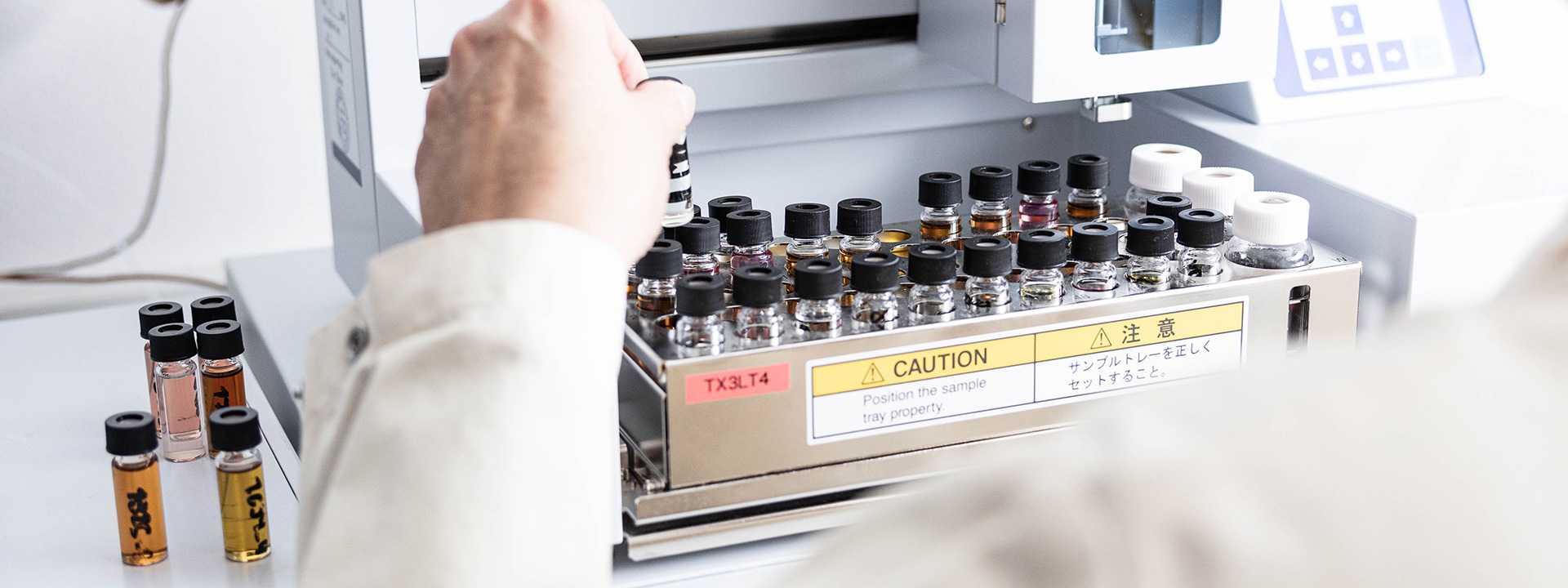
Oxymethylene Ether (OME) Analysis
DIN/TS 51699
| Test Parameter | Method |
|---|---|
| Cetane number | DIN EN 17155 |
| Density at 15 °C | DIN EN ISO 12185 |
| Flash point | DIN EN ISO 2719 |
| Kinematic viscosity at 40 °C | DIN EN 16896 DIN EN ISO 3104 |
| HFRR | DIN EN ISO 12156-1 |
| Sulfur content | DIN EN ISO 20846 |
| Nitrogen content | DIN 51444 |
| Water content | DIN EN ISO 12937 |
| Total contamination | DIN EN 12662 |
| Oxidation stability | DIN EN 16091 |
| Freezing point | ASTM D6660 |
| CFPP | DIN EN 116 |
| Formaldehyde content | DIN/TS 51699 Annex B |
| Trioxane content | DIN/TS 51699 Annex A |
| Peroxide number | DIN EN ISO 3960 |
| Acid number | DIN EN 12634 |
| Steel corrosion | DIN ISO 7120 |
| Calorific value, lower | ASG 3201 |
Frequently Asked Questions about the Analysis of Oxymethylene Ether (OME)
What is oxymethylene ether (OME) and what role does it play as a fuel?
OME (oxymethylene ether) refers to a group of synthetic, oxygen-rich molecules that do not have direct carbon-carbon bonds. Due to this chemical structure, the fuel burns in the diesel engine almost soot-free, eliminating the conflict of goals between nitrogen oxide and particulate emissions. As a synthetic e-fuel, OME can be an essential building block for climate-neutral mobility. Another area of application for OME is the solvent industry. A list of the offered analyses according to DIN/TS 51699 for OME can be found in our test parameter list.

How and from which raw materials is OME made?
The most sustainable manufacturing is via power-to-liquid process routes. Only renewable electricity, water and CO2 (e.g. from the atmosphere or from industrial flue gas) are required as raw materials. The long-chain ethers are synthesized via syngas and methanol as intermediates. In the process engineering design and scaling of such plant processes, our Miniplant LAB offers experimental support between laboratory and production.
What is the difference between OME 1, 2, 3, etc.?
The digits indicate the chain length of the molecule, more precisely the number of oxymethylene units (-CH2-O-). Short-chain OME 1 (dimethoxymethane or methylal) has a very low boiling point and is often used as a chemical solvent. Longer-chain mixtures such as OME 3 to OME 5, on the other hand, have physicochemical properties similar to those of conventional diesel. We use special methods for the exact separation and quantification of these homologous series, more information can be found here: Chromatography in Special Analysis
Can OME be ordered from ASG as a test fuel and what is it used for?
Yes, defined OME blends or pure fractions can be sourced directly for development purposes. This is of interest, for example, for research institutions and applications on engine test benches to test injection systems, exhaust gas aftertreatment and combustion behavior under realistic conditions with reliable references. You can find suitable solutions for your tests in our portfolio for test fuels.
Why does the determination of formaldehyde and trioxane in OME require special analytical methods?
Formaldehyde and trioxane are intermediates of OME synthesis. Due to their potential toxicity and high reactivity, their concentrations in the final product must be strictly monitored and limited (according to DIN/TS 51699 Appendix A and B). Quantification in the trace range is analytically demanding due to the volatility of the substances, but is covered by us as standard by dedicated measurement methods in oxymethylene ether analysis.
How can the oxidation stability and lubricity (HFRR) of OME be reliably assessed compared to fossil fuels?
In contrast to fossil-based fuels, synthetic ethers have low lubricating properties and exhibit a different oxidative aging behavior. The tribological evaluation via the HFRR test (DIN EN ISO 12156-1) and a stability test (DIN EN 16091) are necessary to evaluate whether added additives are effective or whether degradation reactions occur with the molecules. If you have any questions about the differences between renewable diesel alternatives such as HVO or synthetic hydrocarbons and the analysis of fossil diesel, we will be happy to advise you.
The analysis using GCxGC (ASG 2253 or ASG 2502) provides additional methods. You can find more information in the Special Analytics section or upon request.

Download your analysis order form. After filling it out, please send it to us along with your product sample. Please see our Sample Shipping Guidelines.
Do you require specialized analytical methods for other substances or mixtures? Then you'll find what you need in our special analytics services.