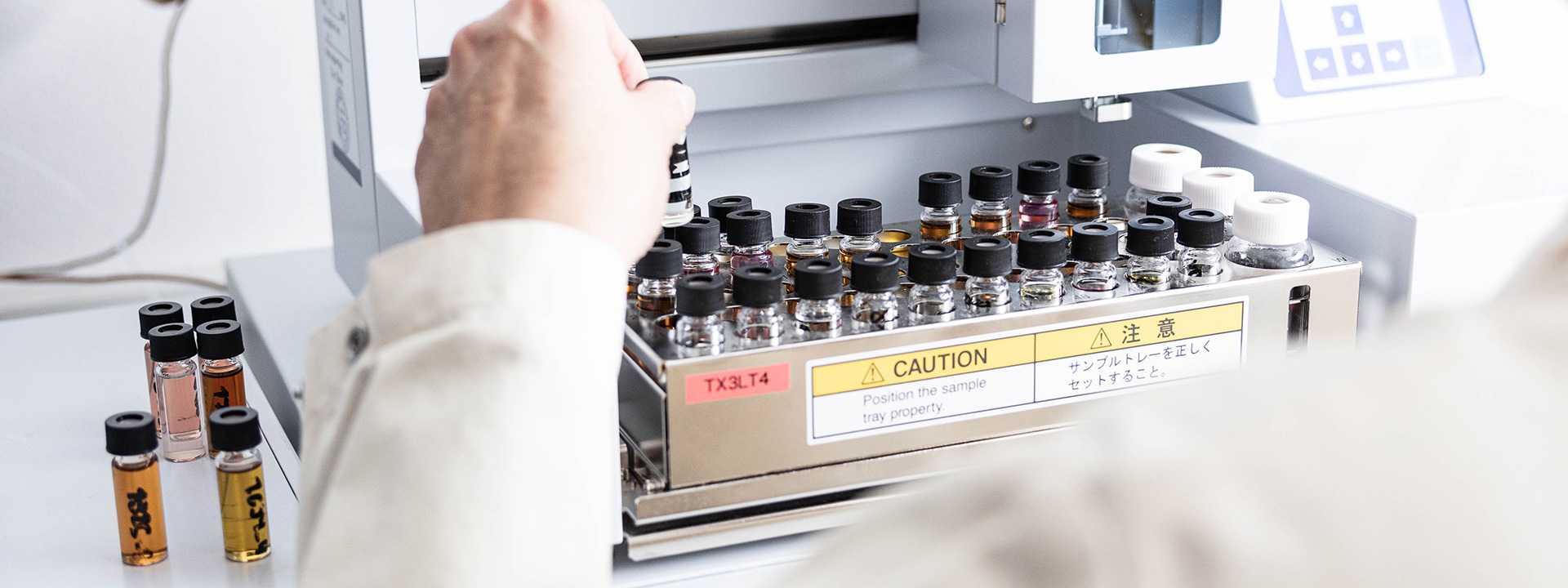
Biodiesel (FAME)
ASTM D6751:2024
| Parameter | Method |
| Sulfur content | ASTM D5453 |
| Cold soak filterability | ASTM D7501 |
| Glycerides content | ASTM D6584 |
| Metals I (Na + K) | DIN EN 14538 |
| Metals II (Ca + Mg) | DIN EN 14538 |
| Flash point | ASTM D93 |
| Methanol content | DIN EN 14110 |
| Water and sediment | ASTM D2709 |
| Kin. viscosity (40 °C) | ASTM D445 |
| Sulfated ash | ASTM D874 |
| Copper strip corrosion | ASTM D130 |
| Cetane number (ICN) | ASTM D8183 |
| Cloud point | ASTM D2500 |
| Carbon residue | ASTM D4530 |
| Acid number | ASTM D664 |
| Phosphorous content | ASTM D4951 |
| Distillation temp. (T90)* | ASTM D1160 |
| Density (30°C) | DIN EN ISO 12185 |
| Oxidation stability | DIN EN 15751 |
*Distillation (T90) can only be purchased together with density (30 °C).
Common Questions regarding Biodiesel Analysis
A supplier offers us an attractive raw material for biodiesel production, can ASG help us to check its suitability?
Yes, we can determine the key figures of the raw material as well as carry out conversion or esterification and thus also analyze the potential end product.
In our plant, distillation is also carried out after conversion and esterification, can this step also be reconstructed at ASG?
Our technical center has a wide range of systems. There, a corresponding distillation step can also be carried out on the basis of your process parameters and its success can be immediately proven in the analysis laboratory.
On the ASG website there are 2 biodiesel specifications, (DIN) EN 14214 and ASTM D6751 - are there any differences?
Yes, these specifications have been designed for different markets, on the one hand for Europe with EN 14214 and on the other hand for ASTM D6751, which is widespread in the USA and Asia. The two standards differ in terms of test parameters and test methods as well as limit values and are therefore not comparable 1:1.
I need analyses of my raw materials and auxiliary materials as well as the intermediates and by-products, can ASG also help me in these areas?
Our range of services covers all areas of biodiesel production, including the testing of products such as vegetable oils and fats, fatty acids, crude or pharmaceutical glycerol, methanol, catalyst (NaOH, Na-methylate, toluenesulfonic acid) see e.g. https://asg-analytik.de/en/analytics/crude-glycerol/
Our biodiesel complies with DIN EN 14214 (ASTM D6751) in all respects, but our customers still report problems. Can ASG also help us in such cases?
Thanks to our more than 30 years of experience in this field, we have already been able to provide useful answers to many customers with complex tasks. To this end, we are not only investigating biodiesel patterns, but also, for example, tank sediments or fuel pump filters.
A potential buyer wants key figures of our product that go beyond the scope of EN 14214 (ASTM D6751). Is this common and what do I have to do now?
In the national and international trade in biodiesel, delivery specifications (e.g. ARGUS) have now been established that include other parameters. ASG routinely offers all possible analyses, such as pour point or fatty acid samples.
Is it possible to determine which raw material was used to make a biodiesel?
Both B100 and blends such as B7 can be used to determine the fatty acid profile of the biodiesel they contain. In the case of pure vegetable oils such as rapeseed, soybean or palm oil, this can be assigned quite clearly, and animal components are also easily detectable. In the case of blends and biodiesel from used edible fats (“UCOME”), the significance is put into perspective accordingly.
Are biodiesel and HVO the same?
No, biodiesel (fatty acid methyl ester, FAME) is produced from biogenic oils, fats or fatty acids through a transesterification or esterification process. HVO is produced by the hydrogenation of vegetable oils, and the hydrocarbons obtained in the process are very similar in their properties to those of a fossil diesel fuel.
The analysis using GCxGC (ASG 2253 or ASG 2502) provides additional methods. You can find more information in the Special Analytics section or upon request.
ASTM D6751:2024

Download your analysis order form. After filling it out, please send it to us along with your product sample. Please see our Sample Shipping Guidelines.


We have been accredited for the
analysis of fuels since 1998.
The flexible accreditation allows the application of accredited test procedures with different dates of publication. Therefore, it may happen that an (outdated) version listed in the official annex to the accreditation certificate D-PL-11334-01-00 is no longer used in the ASG laboratory. A list that reflects the current status of the flexible accreditation is available by pressing the button “method list”.
Do you require specialized analytical methods for other substances or mixtures? Then you'll find what you need in our special analytics services.